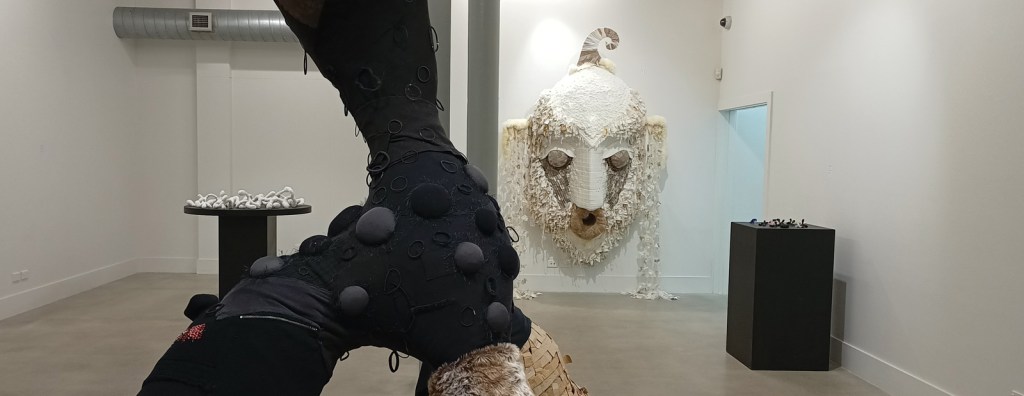
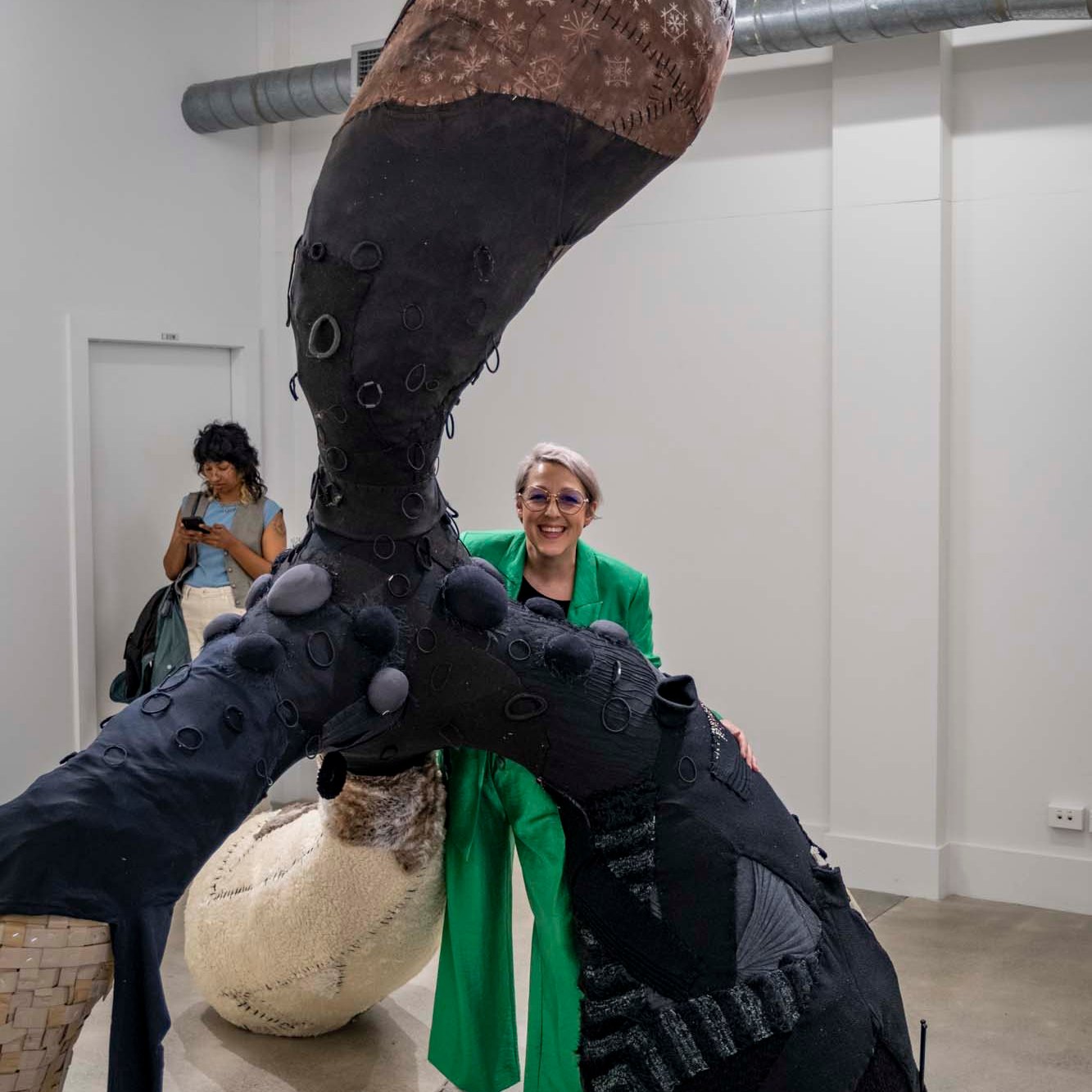
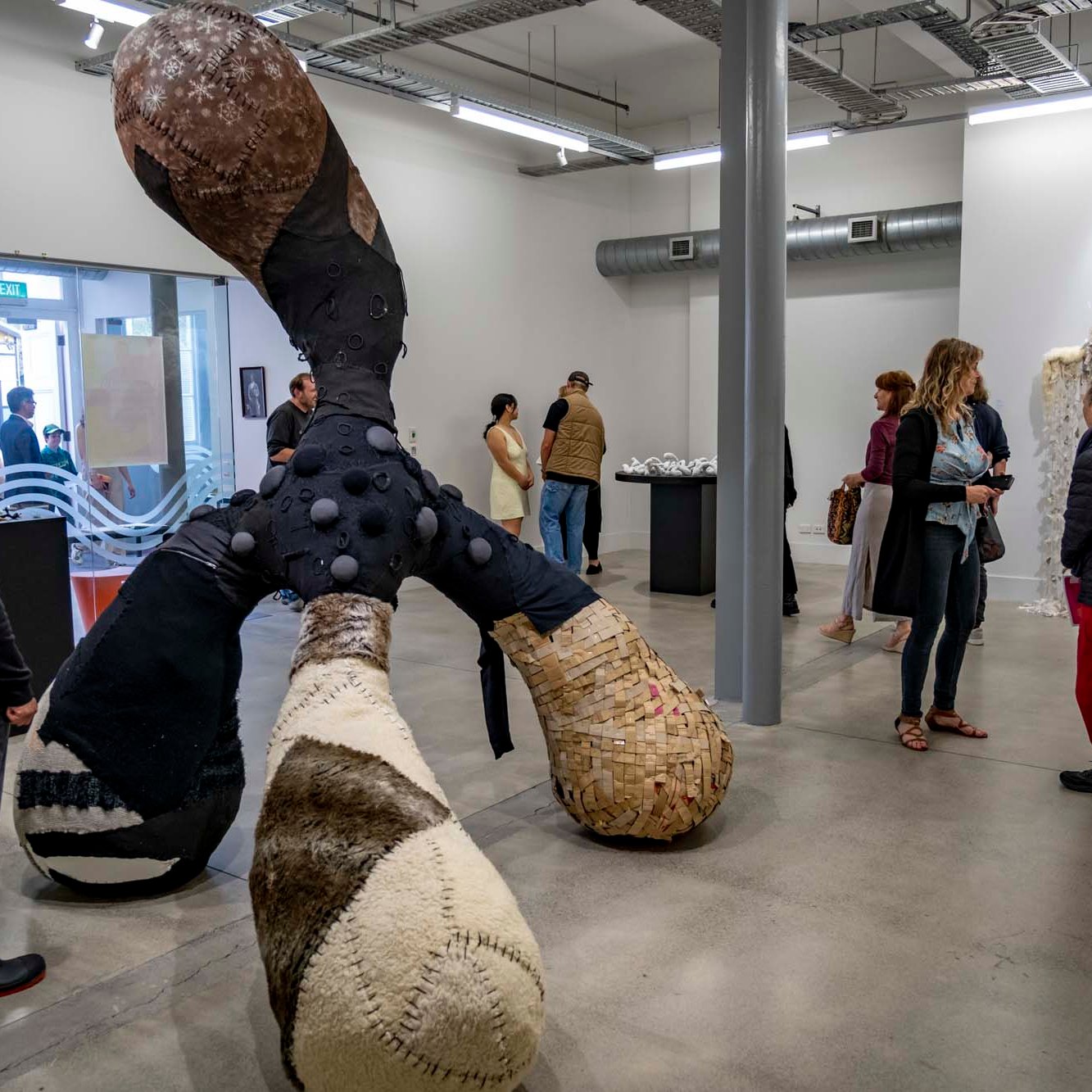
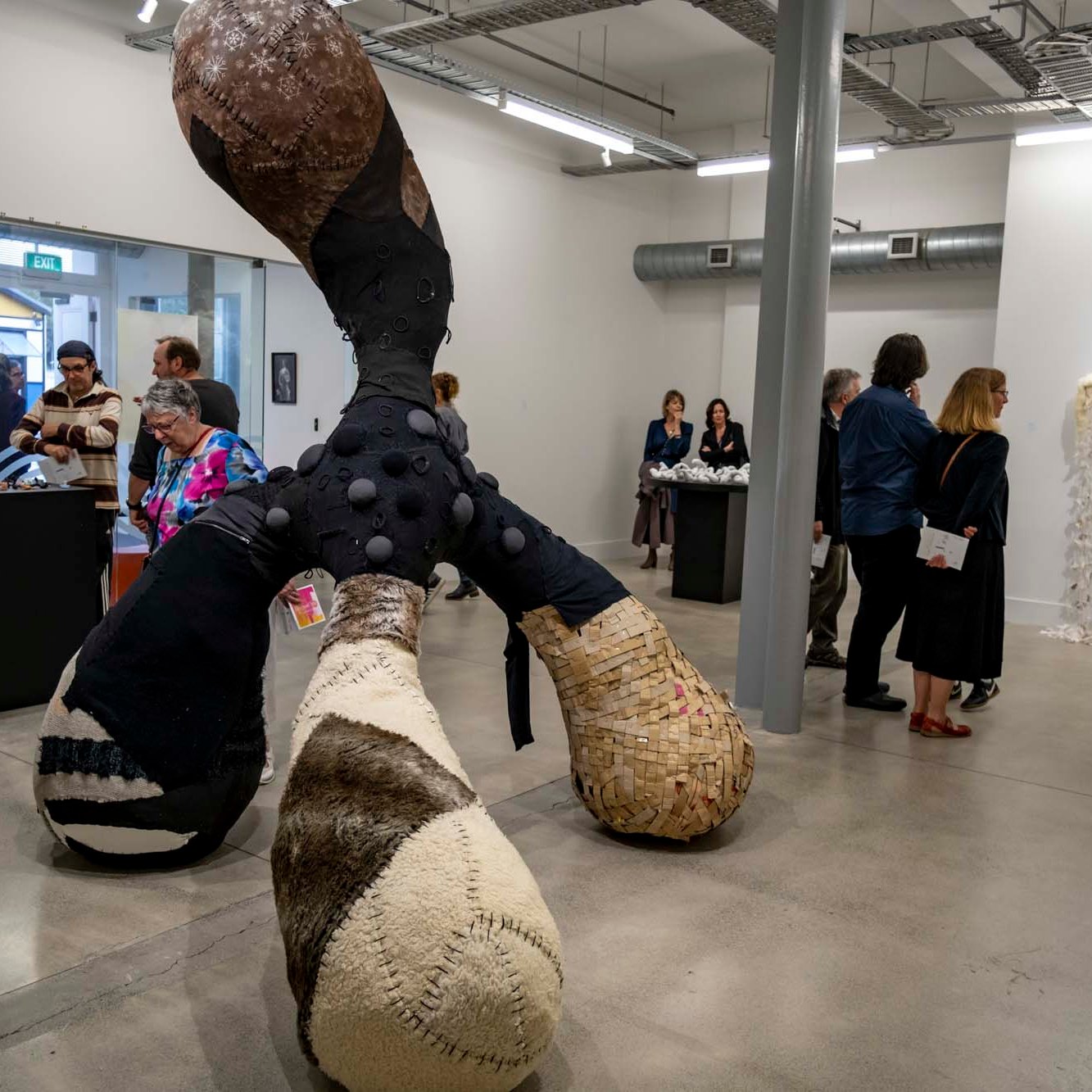
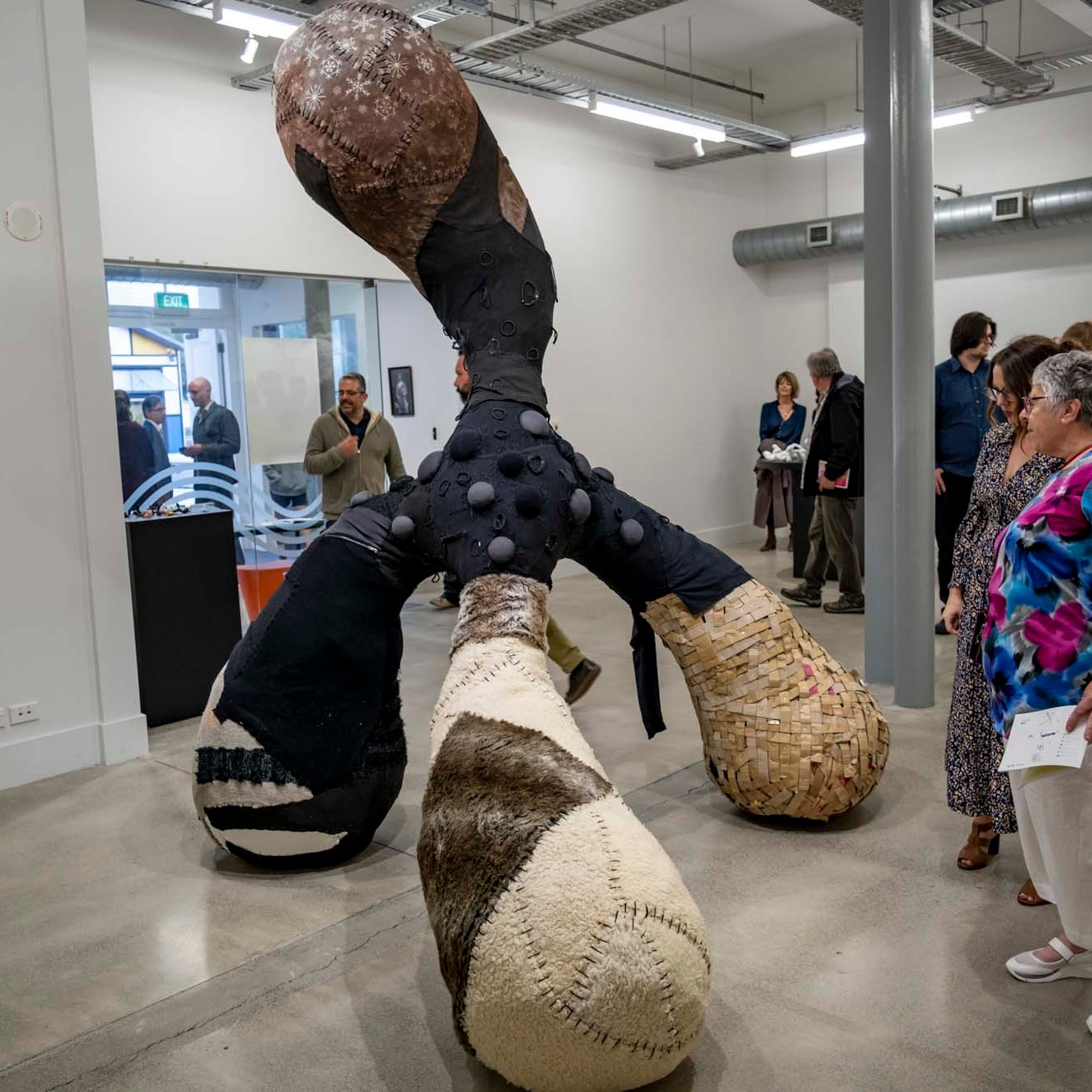
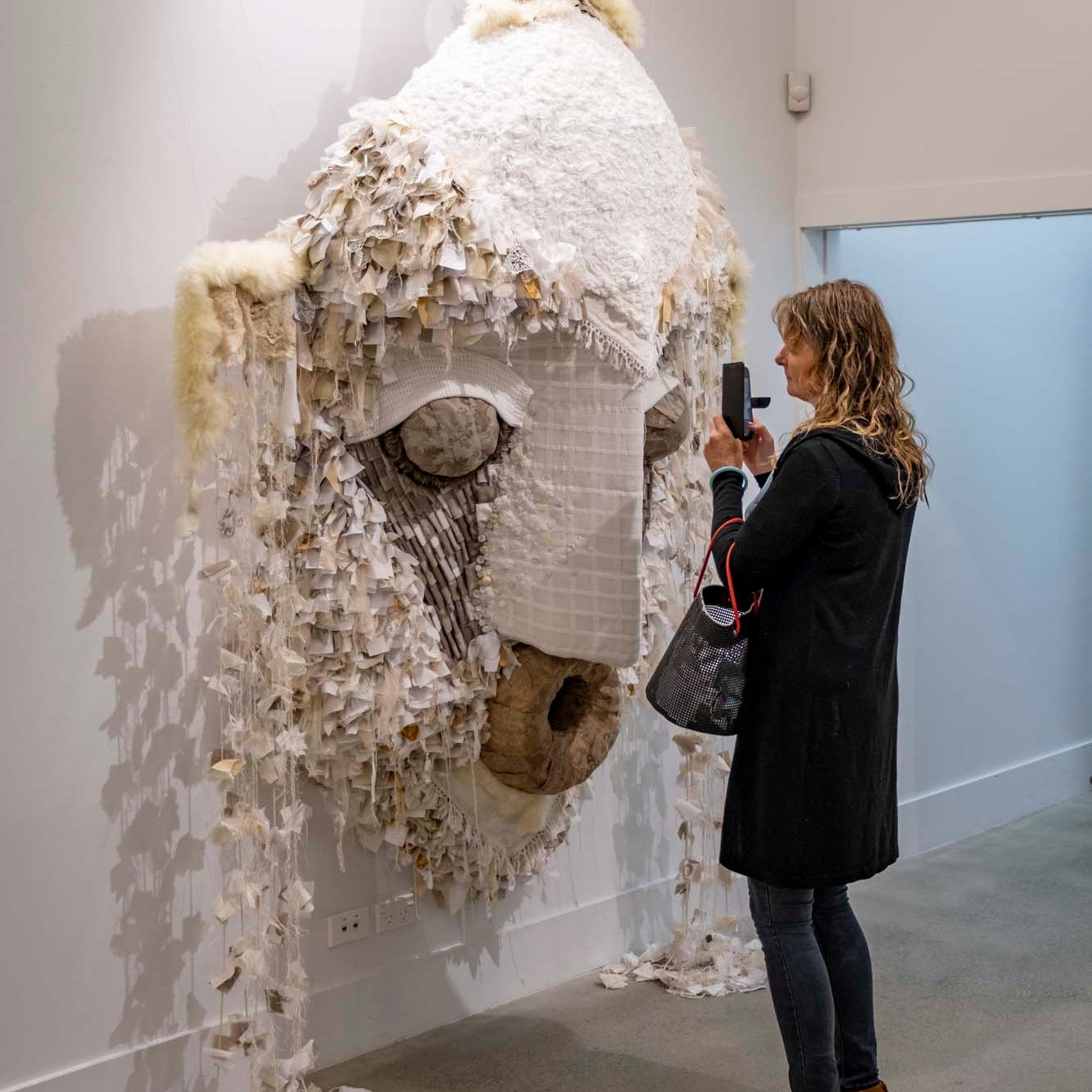
The past five to six weeks have been full on. As Andrea (a ceramist and one of our lecturers) would say ‘head down, bottom up’, I was working none-stop on my two pieces for the student exhibition. For this semester I was exploring and playing with scale/size, and in line with my subject matter (liminality) I made a giant dolos1 (a trickster-like sculpture), called Dolossus, and a giant mask (symbolical death and concealment during the transformational or liminal phase of a rite of passage), called Threaded Deception.
For a long while I was grappling with what to use as an armature for both the dolos and the mask. Chicken wire could work, as could wood. Weight was obviously something to consider, and also sturdiness. A giant version of both these works (2 to 3 metres) means something that can hold its shape and be transportable. Initially I did think of creating the shape of the dolos with fabric and filling it with expanding foam, until I saw the price of the foam and how little volume is made up with a can.
Back to the drawing board, and scanning through Instagram and Pinterest, I saw a post by Ann Weber, and was again reminded of the usefulness and versatility of cardboard. She makes the most beautiful giant sculptures from coloured cardboard. Do check her out. This led me to believe I could recycle cardboard into armatures for my work. Of course she is very skilled and totally in control of the cardboard. Her technique is unique and my goal was not to repeat what she is doing, as this will be covered in fabric in any case.
First off I needed a heavy duty plier stapler, which I ended up buying online, together with some staples which was a lot cheaper than our local store. Collecting cardboard boxes from the skip at the local supermarket was easy enough, and so the process of cutting strips and stapling cardboard together started.
Dolossus
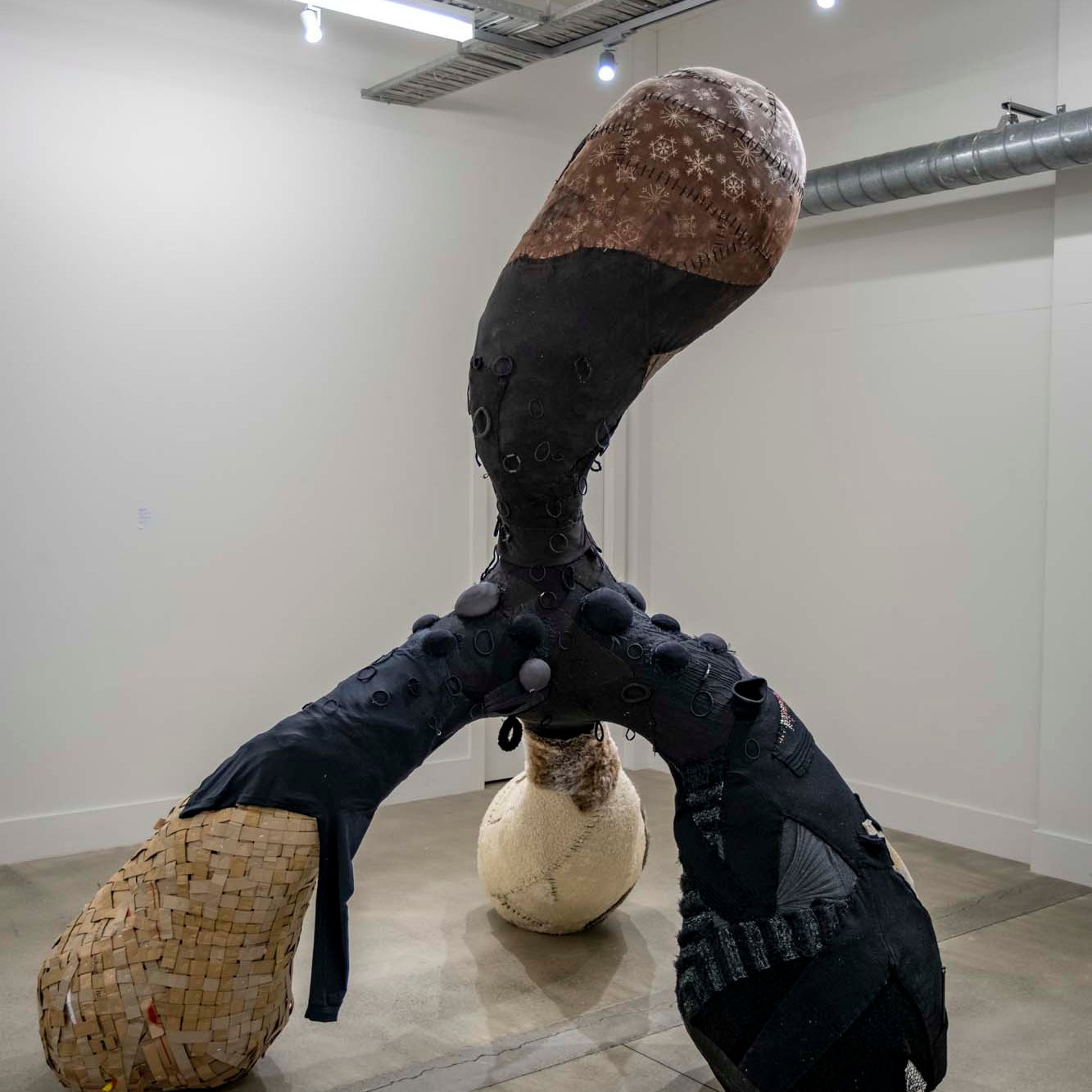
I had no idea how to use the cardboard, but figured I needed to criss-cross strips to create the shape. I therefore started by ‘weaving’ the roughly 3cm wide strips between three structural solid cardboard discs. This ended up to be a very time consuming way of doing, taking about a week to make one ‘leg’. My dolos needed four legs, so for the remaining three legs, I cut wider strips, as wide as the stapler can handle (about 8cm) to speed up the process.
To make the dolos transportable, at least two of the legs had to be able to be removed. Figuring out the body and how everything would be joined was quite the challenge. In the end I decided to create ‘plugs’ about 30cm long where the hollow cardboard leg fits around a smaller cardboard cylinder attached to the body part. It all worked out okay, and I surprised myself with my cardboard box building skills.
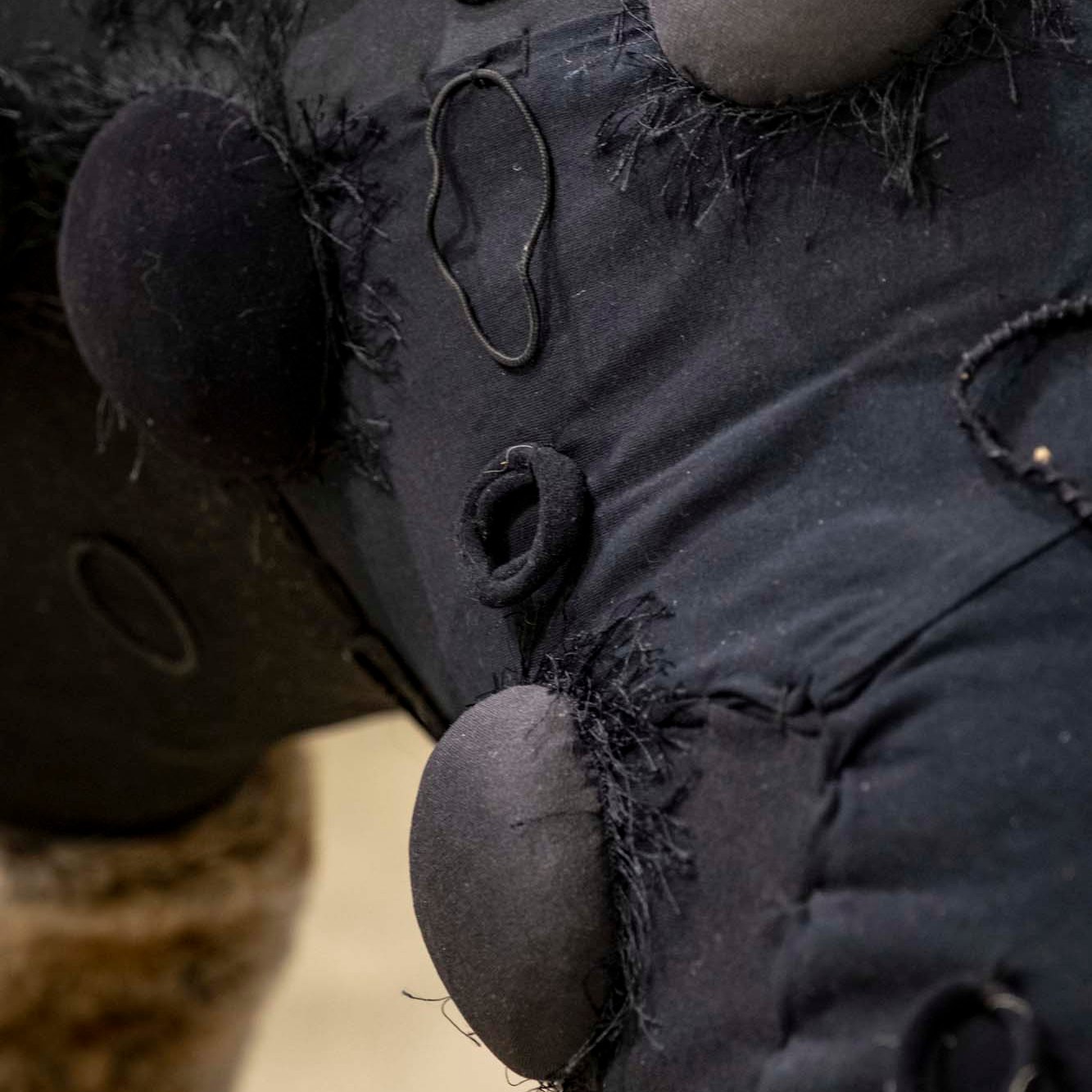
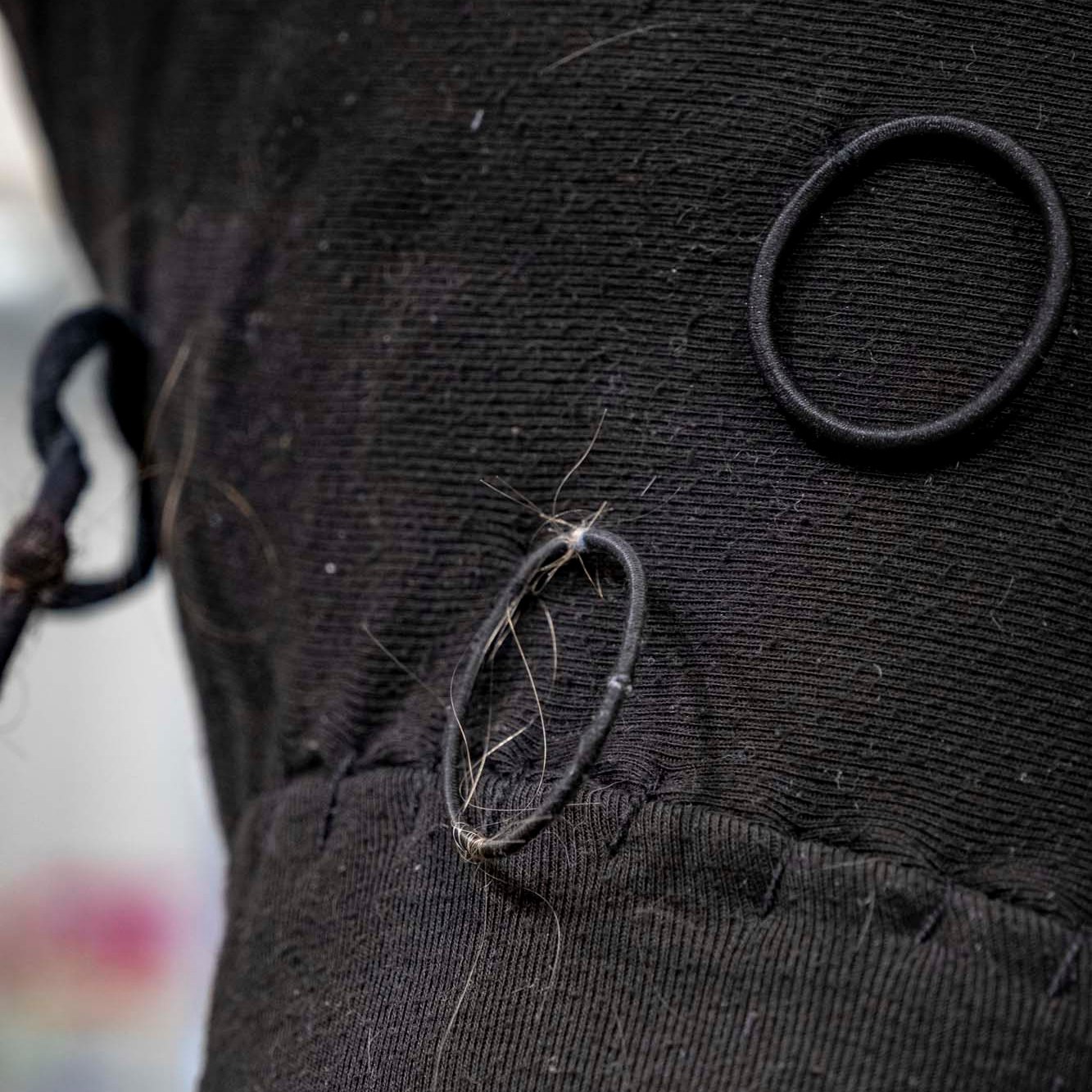
I then covered the cardboard with secondhand duvets, sleeping bags and anything that could smooth out the rugged cardboard and give it a softer, more padded feel. This was then covered with the final layer of different textures: one leg with knitting by using second hand jerseys, one with a throw I found on the side of the road, and one with faux fur and sheepskin, the latter in the form of a mattress protecter from the thrift store. The first ‘woven’ leg I made, I decided to leave partially exposed. The body part was covered in secondhand stretchy clothes.
Some embellishments, big stitches and paint to finish it off, was another few day’s work.
I would have liked to do more, but I wasn’t sure what, and did not want to risk overworking it for no good reason. Besides, time was up.


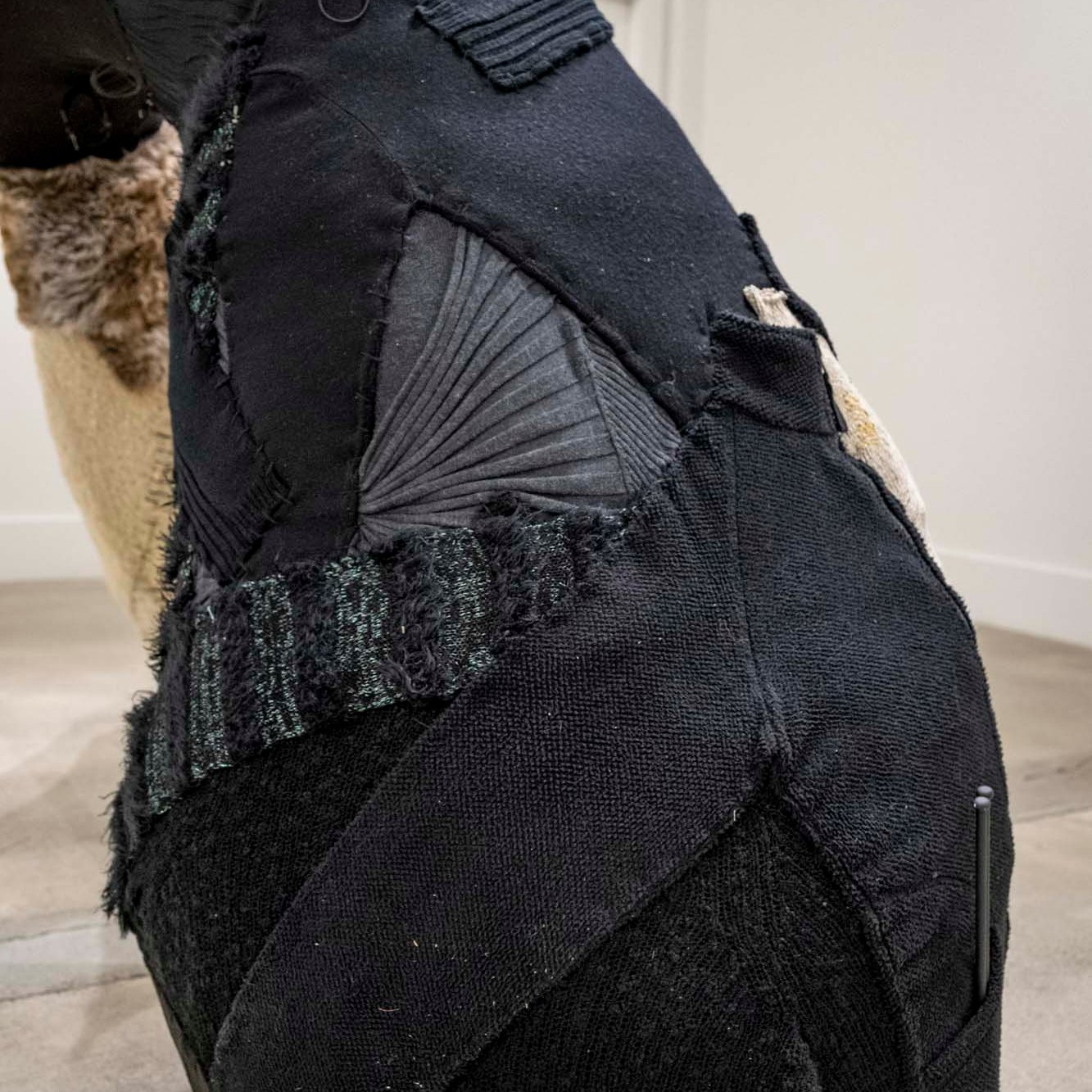

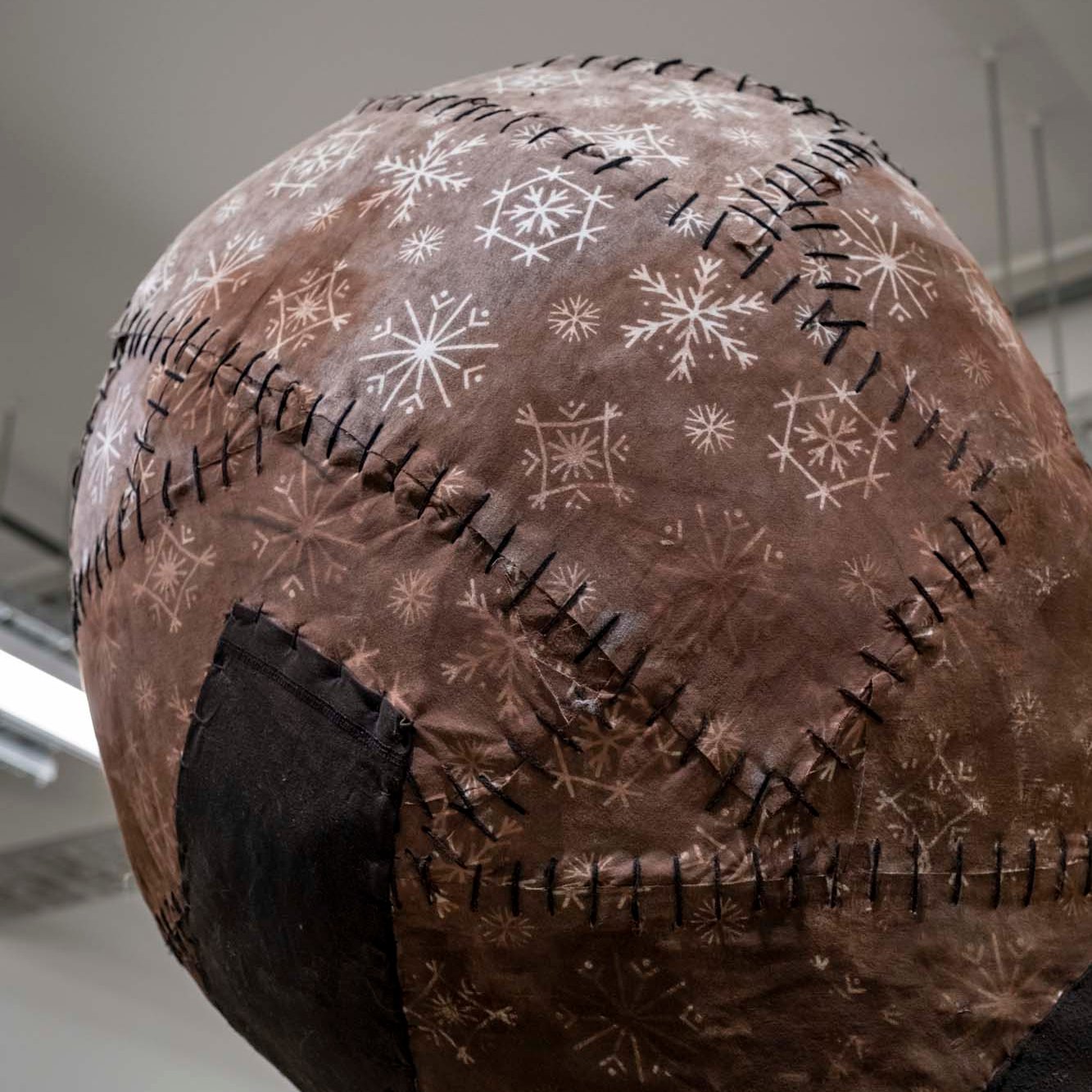
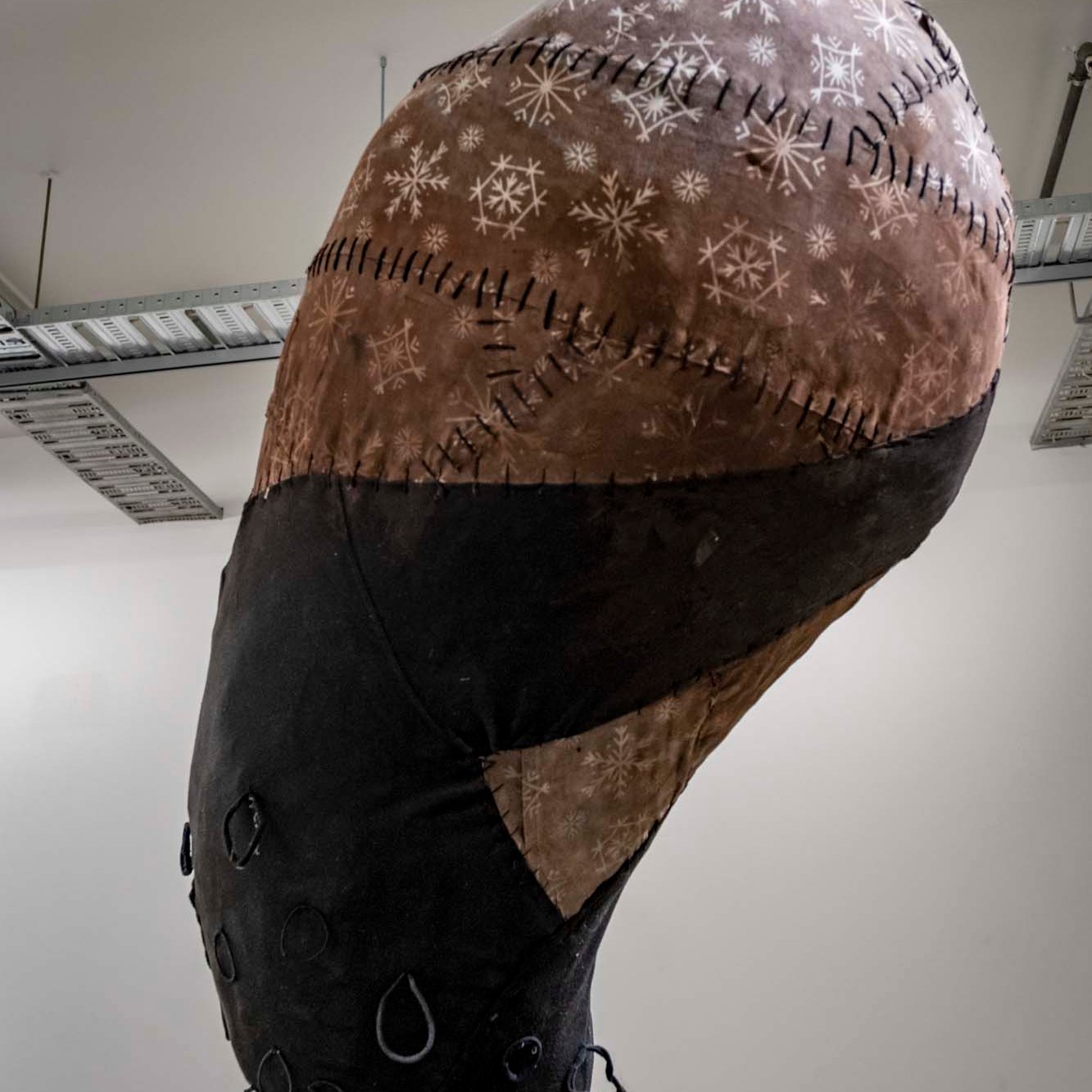
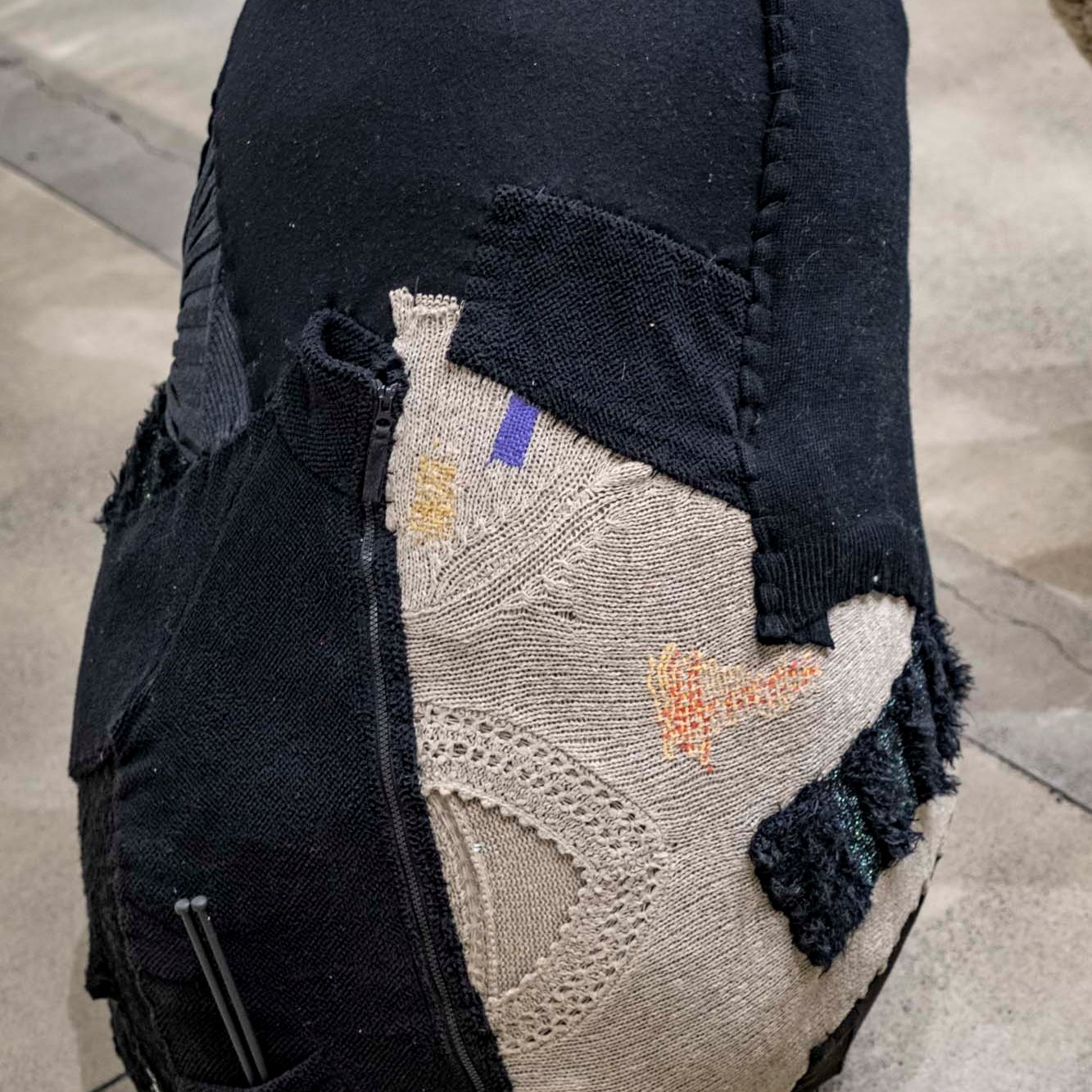
Threaded Deception
Next up was the mask. After a failed attempt to weave something that resembled a mask, I reverted back to the cardboard. I had about three weeks left and had to really get a move on.
Using the cardboard strips again, I fashioned something that looked like a face. What I didn’t realise was that working on the floor, one tends to misjudge size and shape. My mask ended up having a very inferior chin, and one cheek was bigger than the other. I was surprised at how reasonably symmetrical it actually turned out, despite my ‘making-it-up-as-I-go’ approach.
A $6 thrift store queen size duvet was used to cover the whole mask. I roughly glued it to the cardboard, but realised it won’t hold and if the duvet comes off, everything will end up on the floor. I therefore stitched the duvet onto the cardboard by making large stitches through everything. With the mask lying flat between two tables, Gerry ended up helping with the inner most stitches, as I was crawling under the table stitching from below while he was stitching from the top, which saved some time and effort.
Once Gerry held it upright for the first time, I realised how big it turned out. I also realised I might need something other than just attaching fishing line to the cardboard and fabric to hang it from. For this purpose I used two aluminum poles in a cross shape at the back of the mask.
The mask was then mounted on a huge video light stand, so that I can raise it higher and lower to work on it. It ended up being about 2.5 metres high, so even moving it all the way down still meant I had to use a ladder to work on the top metre.
And then I started with the embellishments. While the dolos is predominantly black, I wanted to make the mask predominantly white to symbolise the white face paint of initiants. Inspired by the giant textile masks of Tau Lewis, my hope was to create something different with my own style.
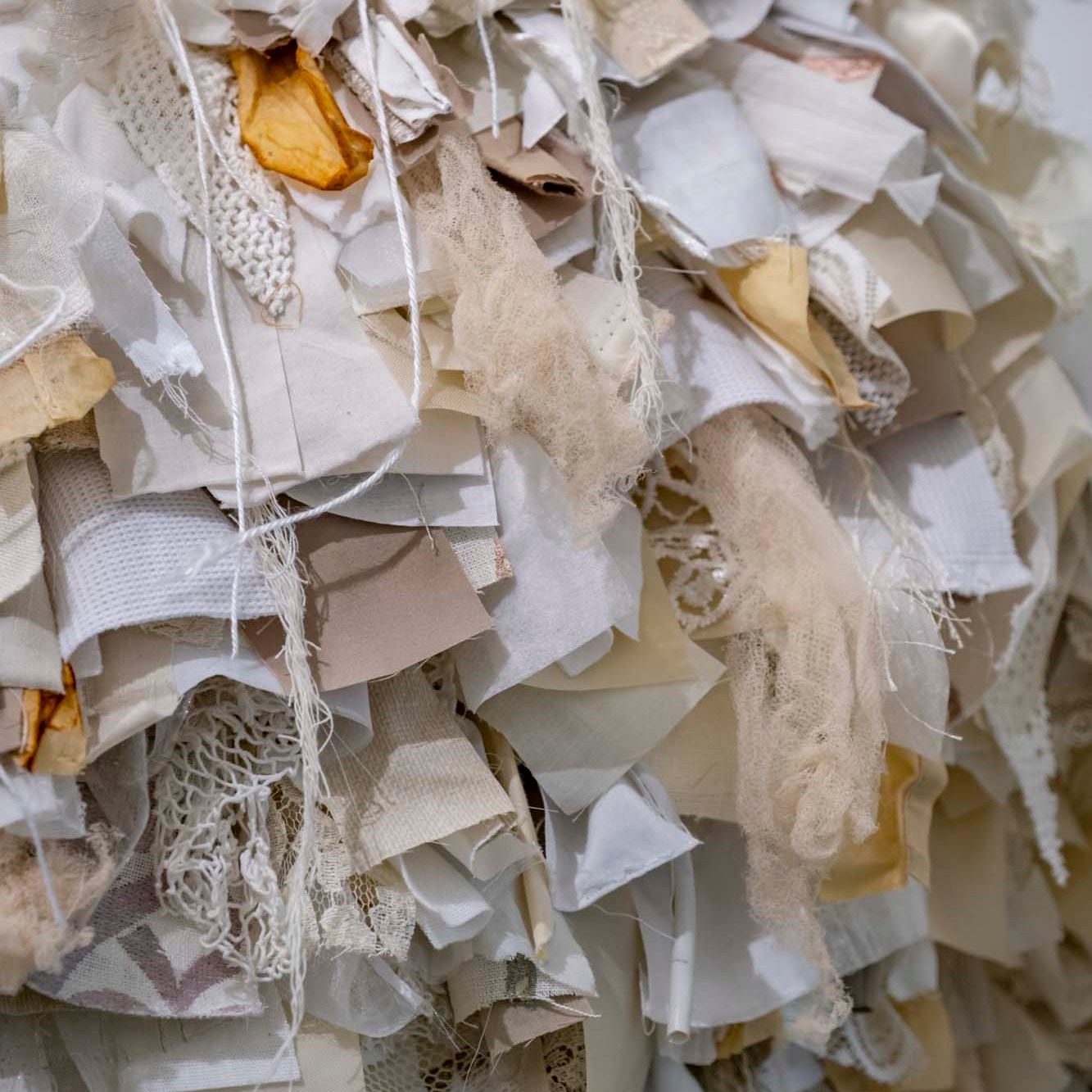
Using discarded clothes, off-cuts and other recycled fabric, I roughly cut thousands of semi-rectangular pieces about the size of a small smartphone to attach like a beard to create lots of texture. Each one was stitched by hand, starting on the chin. I soon realised that it was a very timeous process, and covering a big part of the mask using this technique will take a lot of time.
To create different kinds of surfaces, I applied different techniques on the nose, area, under the eyes, and the forehead. I also glued fabric straight onto the mouth piece and eyes which was also roughly made from cardboard.
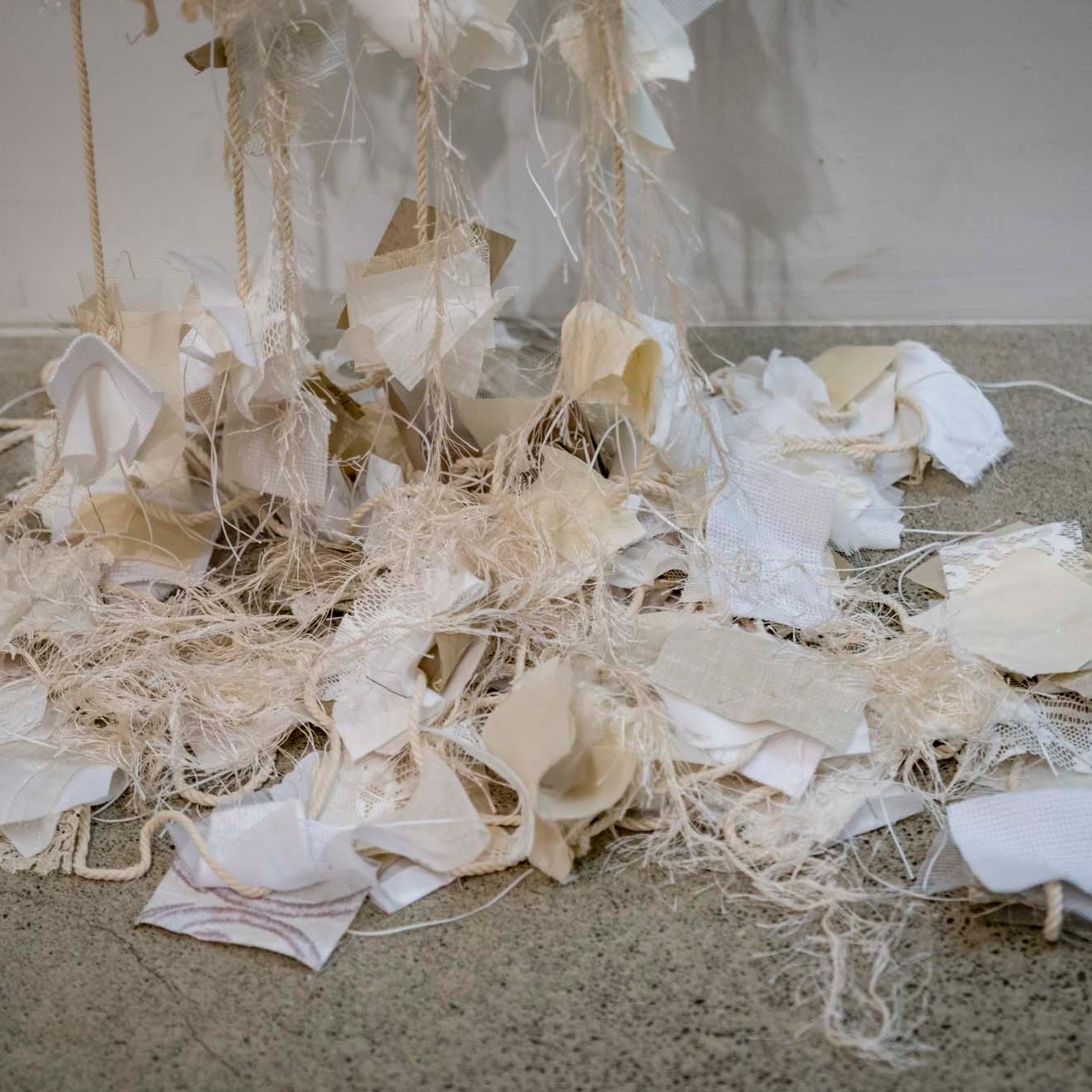
And then there were still three pieces of the structural poles sticking out on the sides and top. I needed to cover these somehow, rather than cutting it off, as the stumps could easily slip out of the still floppy cardboard and fabric piece, rendering the whole mask wobbly. After trying a few things, I ended up tying long strands of rope to the side poles to dangle from the ‘ears’ and sprawl onto the floor. To embellish the ropes, I stitched the left over strips of fabric, but cut in half to form rough squares, to either side of the rope, spaced out evenly.
For the top pole I made a spiral shape curl (that looked like a Kewpie doll) covered in fabric, rope and yarn.





By going large for this semester’s work, I have learned a number of things:
- I really love working at a big scale, but it has its challenges
- it is difficult to judge size and shape of the work
- a lot of time is spent walking around the work or getting up and down a ladder
- large scale works are really hard to transport
- big works are very difficult to enter into competitions
- and then there’s the challenge of storage if it doesn’t sell.
Installation art has always appealed to me. Like Chiharu Shiota’s work. I cannot begin to think how she does it, where to start, how to work from floor to ceiling, sometimes a couple of stories high. I find it fascinating.
But for the purpose of the next paper of my studies, I will scale back to normal size works again.
The exhibition
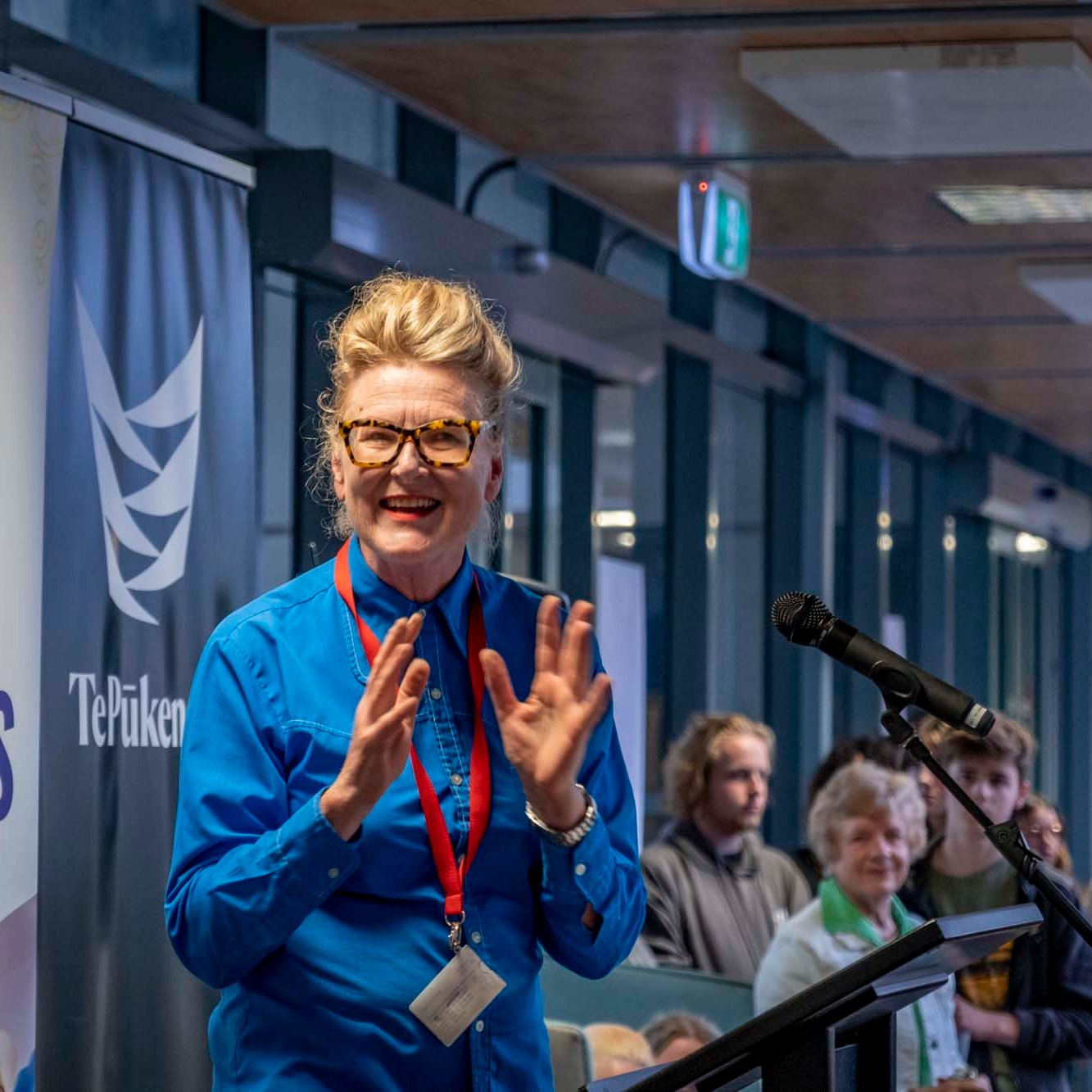
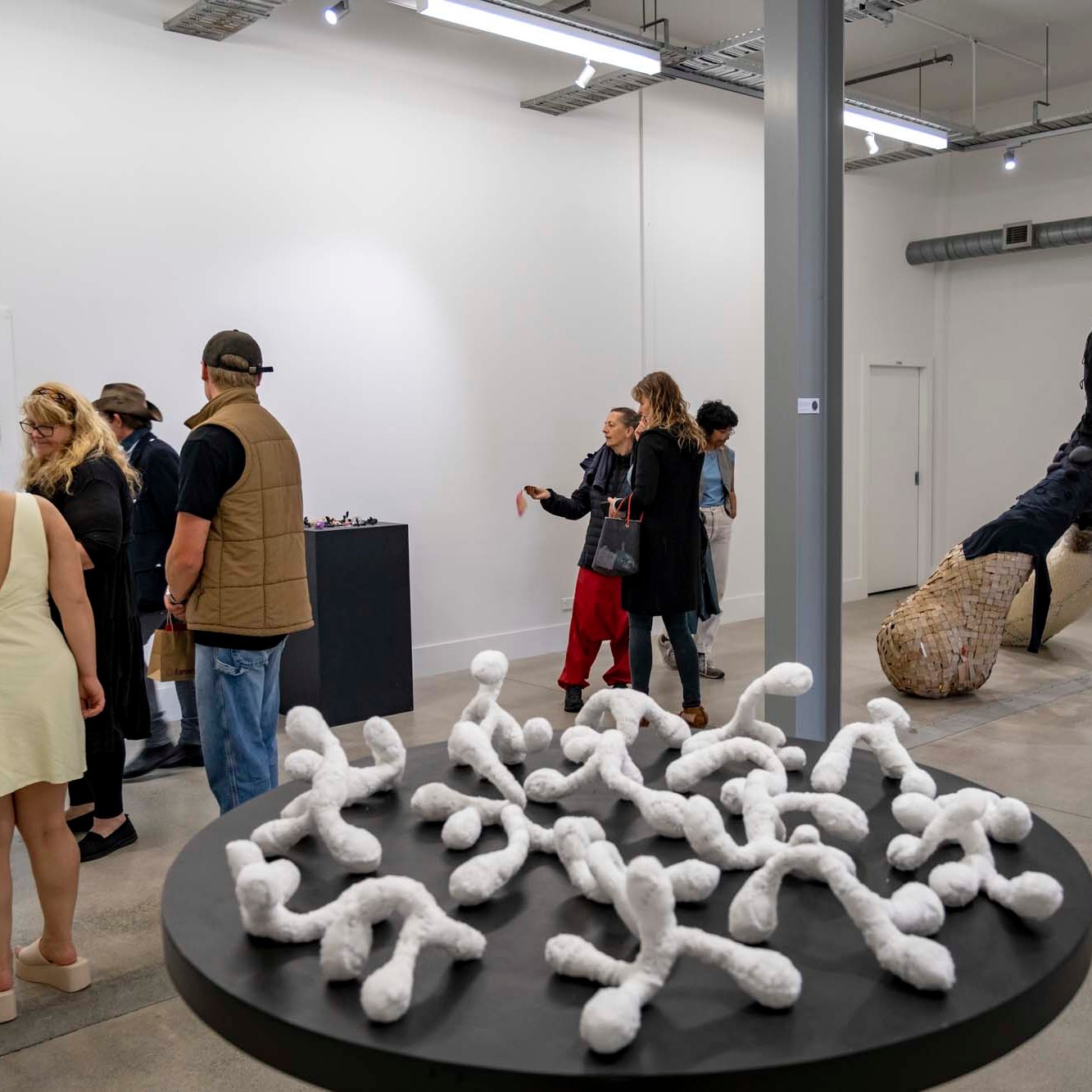
The opening went well, lots of friends and family of all the students made their way through the four exhibition spaces displaying the student work. The feedback was positive and I was again reminded of how lucky I am to be able to study the Master of Design degree full time.
Footnote:
- As an aside, on the word dolos and where it comes from:
The remaining little bones from a goat or sheep sacrificed during the initiation of a sangoma, becomes the dingaka (oracle bones) of the healer. These are used in combination with other found objects to perform the rituals.
In my home language, these are called the ‘dolosse’, which are thrown/cast during divinations, and read in accordance to their position.
‘Sangoma, highly respected healer among the Zulu people of South Africa who diagnoses, prescribes, and often performs the rituals to heal a person physically, mentally, emotionally, or spiritually.
In Zulu tradition, God is rarely involved in human affairs and is not a common cause of illness (isifo). However, God delegated many administrative functions to the ancestors (Amadlozi), who, therefore, are actively and constantly involved in the world of the living. As a result, they are frequently suspected of being responsible for sending isifo to the living. They do this not out of wickedness or caprice but to punish the living for not abiding by the ethical standards of the community and to remind them of their imperative duty to live a moral life. Failure, for instance, to conduct certain important rituals or violation of a taboo may result in the ancestors’ wrath, manifested in the form of sickness. One is then in a state of spiritual pollution and imbalance, which must be redressed. Once a sangoma has used divination to establish the exact cause of illness, certain rituals will be conducted to appease the ancestors, thus restoring health. The behaviour that angered the ancestors will also, of course, not be engaged in again.’
[https://www.britannica.com/science/sangoma]
Also,
1) Before the days of toys, our parents and grandparents played with similar bones and they were also called ‘dolosse’ in Afrikaans.
2) Interestingly, the Greek spirit of trickery is also called Dolos or Dolus. Tricksters, as part of the liminal process, are all around and help to shape the world. In modern times, think Bart Simpson, Frank Abagnale, Bugs Bunny, Tyler Durden, Jerry Mouse, The Joker, Andy Kaufman, The Mask, The Pink Panther, Ct Jack Sparrow, Keyser Söze.
3) And thirdly dolosse is also the name given to the interlocking wave breakers (a wave-dissipating concrete block) developed by a South African in 1963 to combat beach erosion.
↩︎
 Wouna le Roux
Leave a comment