I’ve been postponing writing about my experience doing this degree through UCOL for some time now. Perhaps the fact that it was suddenly something of the past; no more deadlines, and no more worries about delivering something that could get me through, that caused a numbness, a lethargy that led to inertia. Not that making work just to pass the degree was ever my intention. Rather I was hoping to learn as much as possible; about myself, my process, and where I want to go with art. I always knew I wanted to make art, and doing the degree was just a way to really commit and take a step forward.
Once I had finished the degree it reminded me of the day I got my drivers licence – on my 18th birthday no less. It felt like I only really learned to drive properly once I had the licence. I think having the piece of paper as evidence that ‘you are capable’ provides a certain level of confidence – you know you have passed, therefore you should know what you are doing, and therefore you get better at it.

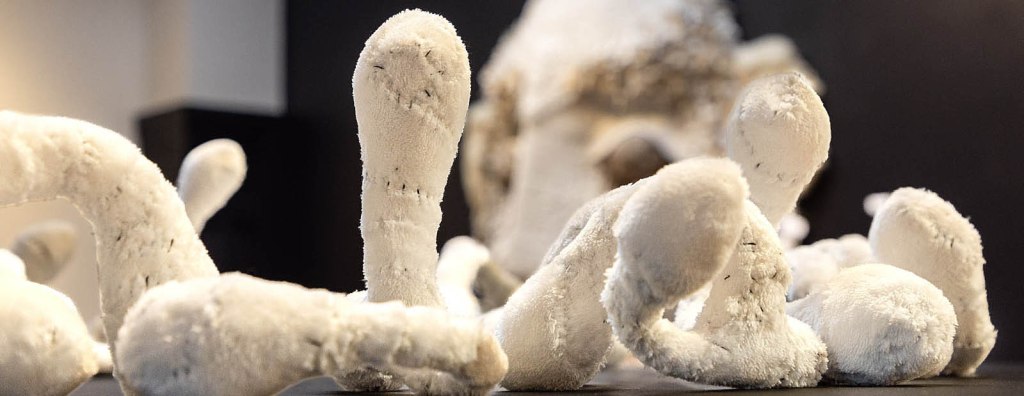
Photo Adele Rycroft/STUFF
Trying to articulate what is was and what it meant to do it, eludes me. I will confess that when I enrolled I was not a hundred percent sure of what exactly I wanted to do, but I was hopeful that doing the degree would give me some sense of direction. Which it did. I had some vague ideas, and through a process of elimination I got to a point where I knew what I liked and what not. I had a better understanding of what it is that I actually want to make. For instance, I know now that my most preferred type of work is installation art. I like art that incorporates its environment and surroundings, like the whole gallery; floor, walls, roof, pillars, everything. I like huge works that can be draped onto or over a building, or wrapping a train or bus, or covering a playground or pathway. I still have big ideas for installation work to comment on the vast amounts of textiles that pollute the environment, the fast fashion, and the fact that no-one bothers to repair anything because it is easier to buy a new one. It is truly sad how consumerism and money are destroying the planet. Be that as it may, it is not going to change anytime soon, and there is nothing I can do about it, except to comment on it, to try and show, and to maybe create some form of awareness through my work.
But I digress.
The first semester of year one was a bit of a hit and miss. I was still experimenting with all sorts of techniques, not sure which way to go. But by constantly doing and ‘thinking with my hands’ I started to realise that I prefer working by hand with a needle and thread. Initially I thought I might get the sewing machine out so my experimenting can go faster, but I soon realised that it is the meditative deliberate stitching that I liked most. The other thing that surfaced early on was that I really like working in 3D. And then it hit me – clothing and anything else made with textiles are 3D by nature. The only time textiles are sort of two dimensional is when it is still on the roll. And even then, depending on the texture, it is not entirely flat.
That was when I started to embrace shape and form a bit more. And having done a PhD in literature on the subject of liminality, it ended up being a no-brainer to work yet again within that theoretical framework. Admittedly I could have done more (one always can) and I could have approached things differently, but at the time I thought I had a sound theoretical grounding to base the practical work on for the end of year exhibition. And so the second semester was ‘easier’ once I figured out what I would like to produce by the end of the year. The how was still a mystery and I had a lot of troubleshooting to deal with, especially since I didn’t want to spent a lot of money. All my materials were recycled, and in line with the underpinning of waste-not-want-not, my aim was to use secondhand or recycled materials for the work as far as possible.
Fortunately friends donated a lot of clothing, and I also received boxes with discarded clothes from opshops. Textile waste is a massive problem globally, together with plastic and paper (the later seems innocent, but in producing a single sheet of paper large volumes of water are wasted, not to mention trees being cut down, mills pumping out smoke and odours, and the list goes on).
For the end-of-year ‘exhibition’ of the first year of the degree, we were told that the work need not be finished, and could only be concepts, or maquettes at best. Somehow my mind did not accept that, and I went on a mission to complete my work to be a ‘proper’ exhibition. Especially after it became evident towards the latter half of the year that the other two students in my group where not going to make physical work and I would have the whole gallery to myself. One’s output was a workshop at a conference, and the other got an extension to only submit early the next year.
Working all hours of the day and night every day for months, I managed to finish my two giant works. The exhibition looked good, I thought, and overall was successful.
Then came year two of the degree, which is only one semester (a bit more than four months if you take away the school holidays).
At the end of the first year, I was invited to exhibit at the local community gallery (Square Edge) in August. This was later pushed out to September. In order to not have to do two exhibitions in succession, and also to have a bit more time to finish the final year’s work, I applied for an extension which was granted. This was particularly helpful as we wanted to visit family early in the year for six weeks. I started right at the beginning of the year to get a head-start, but the six weeks still set me back more than I hoped it would. Nonetheless, with the extension everything worked out fine and I could finish in time for the opening of my end-of-course exhibition on 30 August.
What I enjoyed most about this degree was the fact that you can almost do whatever you want in whatever medium you prefer. The lecturers will guide you through a process of basic research techniques, methodologies, critical thinking, contextualisation, and positioning statements. Although it feels like they apply a ‘hands off’ approach, and you are not learning much about your subject from them, this is not the case. You are after all a grown-up by the time you get there, and should be able to do your own research and become a master in your own field, with guidance from them. It is impossible for the handful of lecturers to know absolutely everything about all theories, subjects and disciplines, and every art technique and medium under the sun. Although they are a very diverse group (we had three official lecturers, and I was able to get advice and inputs from another), each is an expert in their own field. If your field happens to align with one of them, you might perhaps feel like you are getting more from this course?
I am grateful for the opportunity to have been able to do this degree. Without the partial subsidisation from UCOL, I would not have been able to afford it. Through doing the degree I also made connections, and had exposure and opportunities that I otherwise would not have had. It is difficult to ‘make your mark’ or make connections as an early career artists if you spend your days in a studio tucked away in your backyard all alone. Having said that, my hope is still to have a home studio one day, but to have workshops and others joining me there where we can make and create together.
I am positive about and keen to see what the future brings. I’m excited to keep exploring and to keep making, to search for opportunities, and to be out there finding my feet. Since the installation of my exhibition, I have applied for a grant and submitted work for a competition. New work which I’m very excited about. This will definitely be a new body of work, and I can’t wait to get stuck in and make more.
 Wouna le Roux
Leave a comment