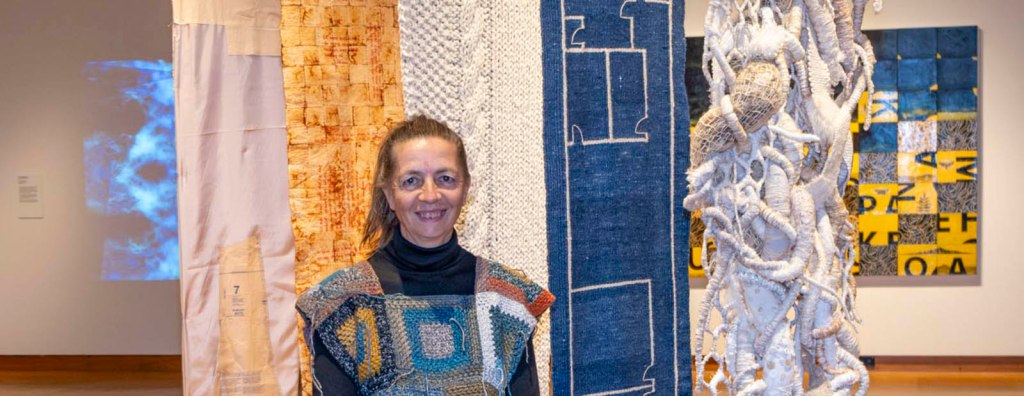
After finishing my Masters degree in 2024, I was flat out working on my piece for an exhibition by Te Awahou Collective, called Te Puna o Te Atua, at Te Manawa.
But let me backtrack a little.
Towards the end of 2023, I met Albert McCarthy through Gary Whiting who is a lecturer at UCOL. While working on the pieces for my studies, I had a ‘studio’ in the corner of one of the rooms at UCOL. Albi and Gary (and Phill, another lecturer at UCOL) had regular meetings, often at UCOL, to plan the way forward for the group, including upcoming exhibitions. On one such occasion Gary introduced me to Albi, and looking at my work, Albi invited me to be part of the group – Te Awahou Collective. I was honoured and thrilled to be part of a collective of mostly Maori artists. Albi identified my ‘Dolossus’ as a piece to be included in their exhibition at the Māpuna Kabinet Art Gallery at the end of January 2024, only a few weeks after I first met Albi. The exhibition booklet was already in the making, and artists were interviewed and captured on video to be included in the website. It was very daunting to talk about my work while being videoed, especially as it was my first time doing anything of this sort. Everything happened at pace, including writing the artist statement, pricing and other related admin to have everything ready for the exhibition. We already had plans to visit family in South Africa, so I dropped off the work in Foxton at the gallery before driving to Wellington for our flight. I could unfortunately not be at the opening a week later.
After this exhibition Te Awahou Collective had the opportunity to exhibit at Te Manawa. A great honour and an opportunity I took very seriously. I’m still pinching myself when I think about it. Numerous meetings and discussions took place in the months that followed to sass out all the details in terms of what everyone would be making for the exhibition. In November 2024, we had our first meeting with Te Manawa as a group to present our ideas. This meant that they could do a first AI ‘walk-though’ concept to show where each piece wil go, and how it will be displayed. While I still had the idea that I would produce a huge woven piece (3×6 metres at least), I became aware that most of us wanted to make large work, and so I changed mine to include several smaller panels which could be reduced should space become a problem.
But as time went on, I started narrowing down what it is that I actually wanted to make. This was partially influenced by an application for funding which required a bit more detail in terms of how the money will be spent. Although my work was still on the larger side of things (final measurement about 700x2500x2500mm) it was more contained than before, and certainly more to the point. Once things started to fall into place, it was just a case of making. Although the work was made as a hommage to the women who helped shape my love of textiles, it turned out that the biggest player was actually my mother.

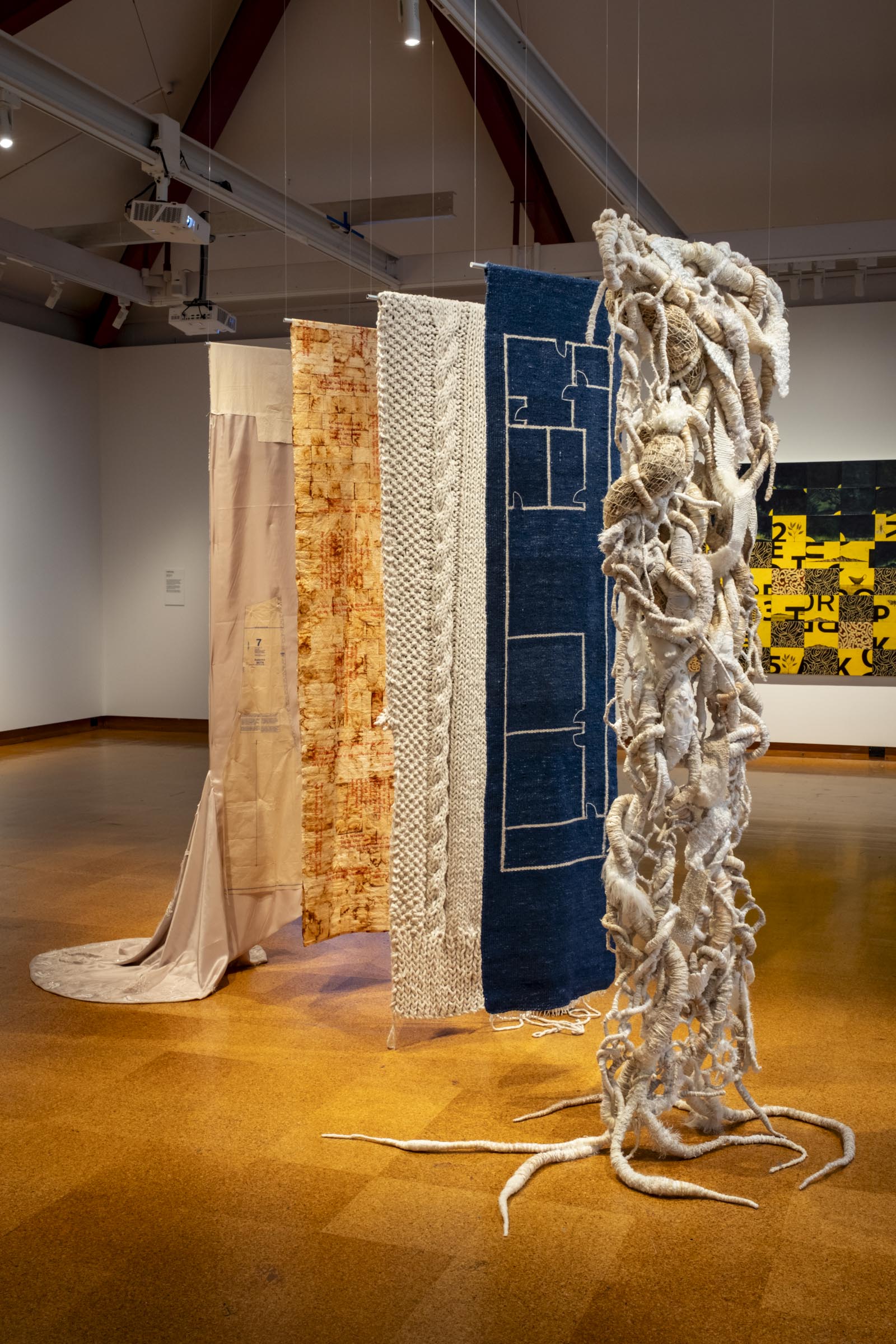
In the end my work consisted of five panels, each being 500x2000mm and double sided, hung with fishing line to face each other 500mm apart. These panels were made to show a progression of my life in textiles. As my mother, and my mother’s mother, I started out as a ‘dressmaker’. With my mother’s help I made garments at a very young age. I also learned to knit and crochet as a child. Although I never pursued a career in fashion design or dressmaking, my love of textiles never went away.
The first panel was something that resembled a ‘dress’, and the dressmaking process. I included pieces of a pattern, pins and finished the train, akin to a wedding dress, with embroidery and beadwork.
The second panel is something that’s been very dear to my heart. Red bush tea is just about the only liquid that ever passed my mother’s lips. She didn’t drink alcohol, didn’t like coffee and didn’t fancy salon tea, and carbonated drinks were not even remotely on the menu. So I made a patchwork from my own used red bush tea bags. Once finished, the 500x4000mm size cloth was embroidered with my mums favourite Bible versus. I used red thread to echo the red bush as well as comment on ‘redwork’. Turkey red (made from the madder root) thread was initially the only colourfast dye which was used in the eighteenth century as part of ‘women’s work’.
The third panel I wanted to be a large piece of knitting. My mum loved to knit (something she did up until the week she died) and was quite good at knitting fancy cables and patterns. I therefore used a thick yarn (it was actually mop rope I bought while in South Africa) to knit a huge cable – the first cable I ever knitted.
The fourth panel was a woven floor plan of the semi-detached house we lived in after my parents got divorced. I wanted to use blue wool, which I dyed using woad, to echo a blueprint of the house plan.
The fifth panel is a metaphor for reintegration, setting down roots and the interconnectedness of everyone and everything. This is a new line of work that I have started to explore not long after I finished by studies.
A little more on the individual panels in a next post.
It was an absolute pleasure dealing with Te Manawa. Everything went very smoothly, and they accommodated every artist’s wishes as far a possible. Having a solo exhibition at Te Manawa would be a dream come true.
This video snippet shows the procession and official blessing of the gallery space and artworks by Huataki Whareaitu and Reweti Arapere at the opening of Te Puna o Te Atua on 16 May.
With thanks to the Earle Creativity and Development Trust for partial funding of the project.

 Wouna le Roux
Leave a comment